Macomate 88
Resonator instrument with a companion FX plugin for tuned feedback, alternative tunings, and pitched textures
About
Macomate 88 is a resonator instrument built from 88 tunable comb-filter voices. It comes with Macomate 88 FX, a companion audio-effect plugin for transforming incoming audio into the great terrain between sustained tones, a chaotic ocean of noise, and (sometimes) surprisingly ordinary reverbs. It is based on a modern rebuild of an older mutagene plugin and is intended for sound design, tuned resonance effects, and experimental music production.
Thus called because you can enable up to 88 simultaneous resonators, though in general usage you might want to stick to between 4 and 20, I figure.
Uses
- Tuned resonances from any input signal
- Playable resonator/instrument patches from MIDI
- Reverbs that morph into other things
- Sustained tones with MIDI-triggered envelopes
- Feedback-based textures (delay, filtering, waveguide/rattle path)
- Microtonal and alternative tuning workflows (see below)
Targets
- Macomate 88 — VST3 instrument / VSTi. MIDI note-on events excite the resonator bank directly.
- Macomate 88 FX — audio effect. Incoming audio feeds the same resonator bank, with MIDI available for note selection, envelopes, feedback control, and snapshot recall.
Tuning
Pitch is stored internally as a 128-note cents table. The comb filter bank,
feedback delay, and pitch quantizer each maintain their own map. Built-in
presets are included; maps can be loaded from .tun or Scala (.scl, with an
optional .kbm mapping file) and exported as .tun.
For sessions that use an MTS-ESP master, each of the three paths can be set to:
- Local map — tuning is edited and stored in the plugin (default)
- MTS-ESP follow — the map tracks the connected master while the mode is active
- Import once — copy the current master tuning into the local map, then work offline from that snapshot of the scale
When follow or import once is selected, the status bar reports MTS connection and scale state. With no master connected, follow mode leaves the existing local map unchanged.
Comb filter bank snapshots (eight slots) can each store their own comb tuning source mode alongside the grid, so recall restores whether that slot was using a local map or an MTS workflow. Feedback and quantizer MTS source settings are global.
Interface
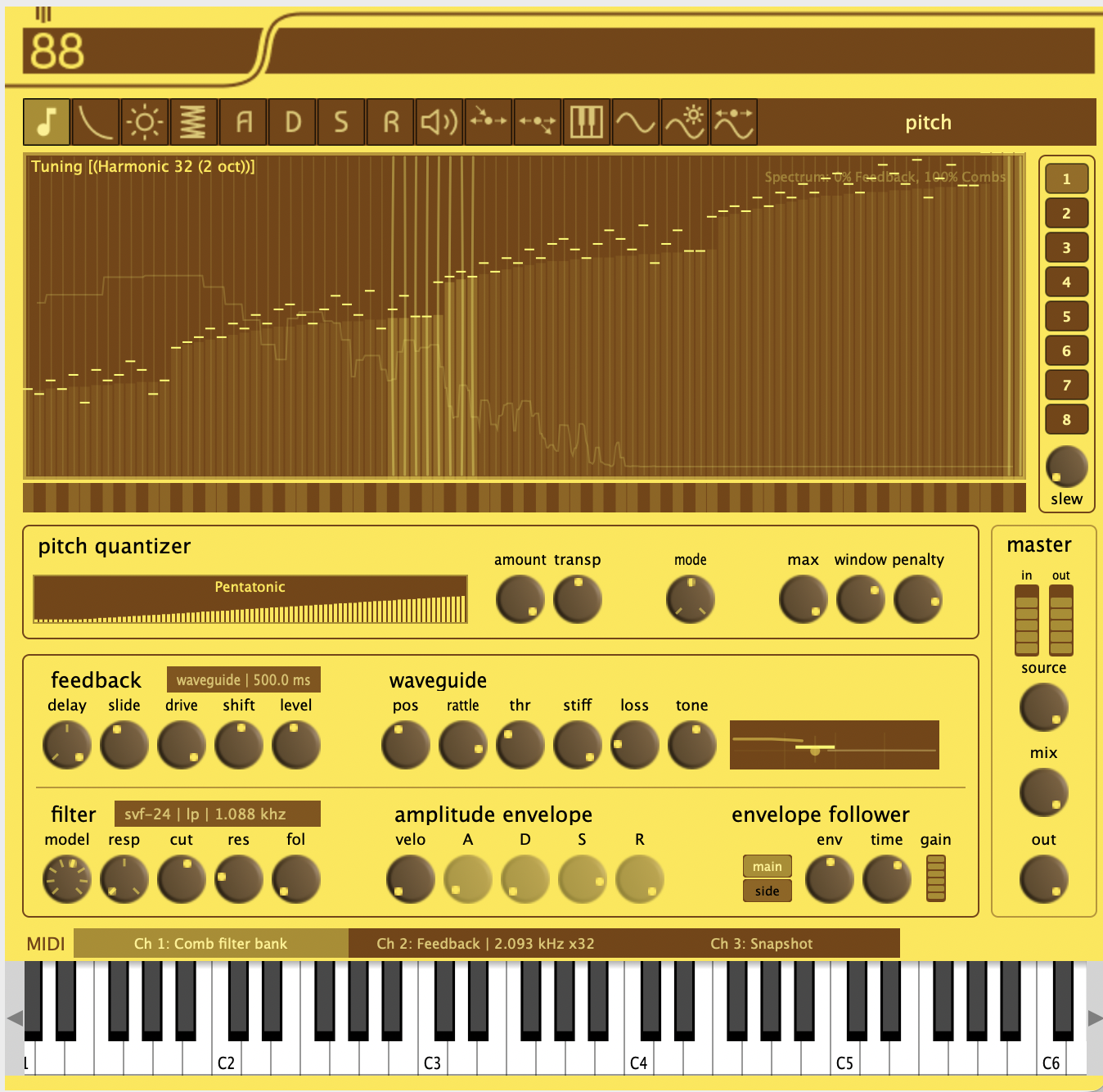
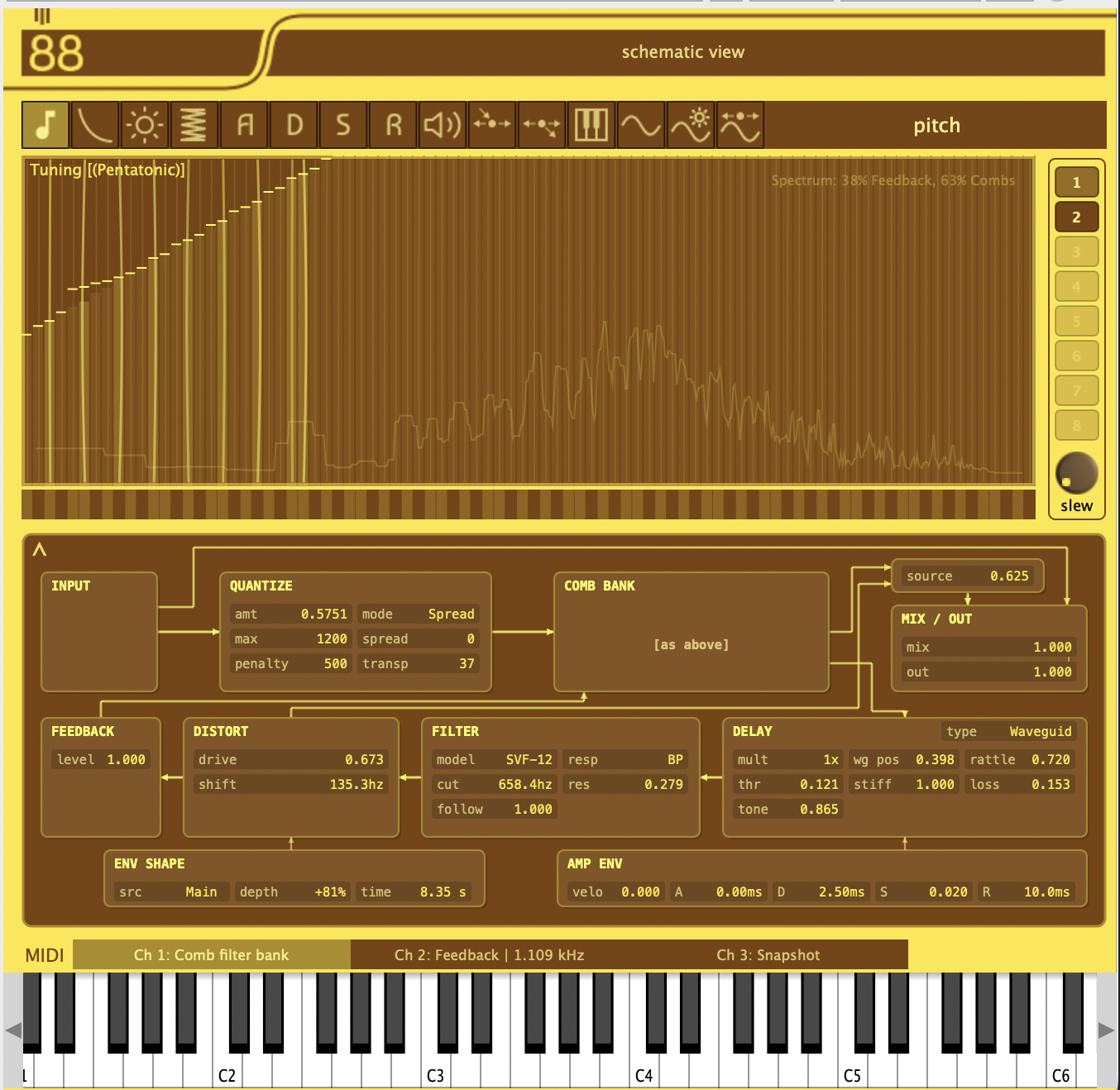
The editor provides a knob layout and a schematic signal-flow view of the same parameters. Snapshot recall and morphing apply to the comb grid and related comb-path tuning metadata.
Formats
- Macomate 88: VST3 instrument
- Macomate 88 FX: VST3, AU, and Standalone effect
- macOS and Windows desktop release packaging
Changelog
Version 2.0.0
- Modern rebuild of the original Macomate plugin
- Adds 'tape delay' path and 'waveguide path' with optional rattling / loose string settings
- Adds more filter options for the feedback path, including some experimental designs
- Knob and schematic signal-flow views
- Tuning: built-in presets,
.tunimport/export, Scala (.scl) import - MTS-ESP follow and import-once modes for comb, feedback, and quantizer maps
- Per-snapshot comb tuning source (local map, MTS follow, or import once)
- Status bar indication of MTS connection and scale when follow/import is active
- Expanded feedback path (filter models, waveguide/rattle, pitch quantizer)
- VST3, AU, and Standalone on macOS and Windows